Creator business
How much does YouTube pay? Monetization and AdSense, no illusions
The right question isn't “how much does YouTube pay per 1,000 views” — because there's no fixed number, and anyone giving you an exact rate is selling an illusion. The right question is: how YouTube pays, what you can realistically expect (and why your audience's geography decides it), and why a better video earns you more than any ad-setting tweak ever will.
~10 min read

1. Turning on monetization: YouTube's two tiers
A lot of people think monetization only starts at 1,000 subscribers. Since the Partner Program (YPP) expansion, which reached Brazil between 2023 and 2024, there are two tiers — and the first one comes well before ads.
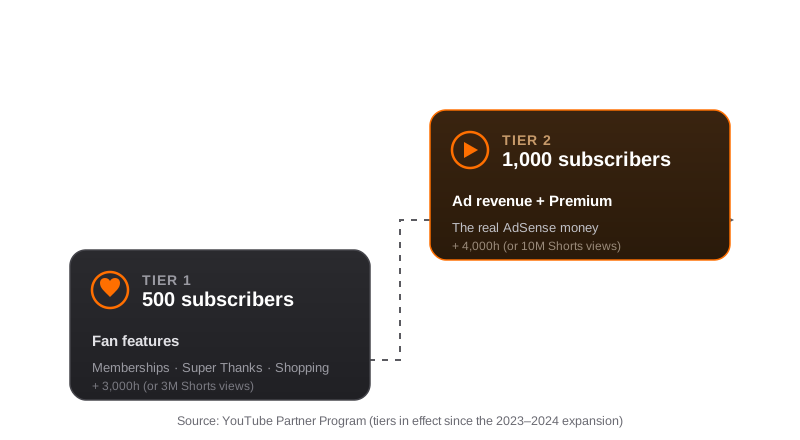
- Tier 1 — fan features (500 subscribers) — with 500 subscribers, 3 public videos in the last 90 days and 3,000 watch hours (or 3 million Shorts views), you unlock memberships, Super Thanks/Super Chat and YouTube Shopping. It's NOT ad revenue yet — it's money that comes straight from your audience.
- Tier 2 — ad revenue (1,000 subscribers) — with 1,000 subscribers plus 4,000 watch hours in 12 months (or 10 million Shorts views in 90 days), you enter ad revenue and your share of YouTube Premium. You can get there on Shorts alone, without ever posting a long-form video.
- The prerequisites that trip people up — zero active strikes, 2-step verification on, advanced features unlocked, and a linked AdSense account. After you apply, the review takes about a month — it isn't automatic.
2. RPM vs. CPM: the acronyms everyone mixes up
These two acronyms explain why two channels with the same view count earn such different amounts:
- RPM (your number) — it's how much YOU pocket per 1,000 views of the video, after YouTube's cut and adding everything up (ads + memberships + Premium + tips). The denominator is your TOTAL views, including the ones that showed no ad at all. It's the creator's business metric.
- CPM (the advertiser's number) — it's how much the advertiser pays per 1,000 ad impressions, BEFORE YouTube's cut, counting only the ads actually shown. It's an input, not your pocket.
- Rule of thumb — RPM usually lands between 25% and 50% of CPM. If someone shows you a fat CPM, remember that what reaches you is a fraction of it.
And the revenue split changes by surface — which is why saying “YouTube keeps 45% of everything” is wrong:
| Surface | You keep | YouTube keeps |
|---|---|---|
| Long-form video ads | 55% | 45% |
| Shorts ads | 45% (of the pool) | 55% |
| Memberships, Super Chat / Thanks | 70% | 30% |
| YouTube Premium | ~55% (prorated by watch time) | ~45% |
3. What you can REALLY expect (no hype)
Here's the part the “get rich on YouTube” videos hide. The numbers vary a lot; everything below is a range, an order of magnitude — never a promise.
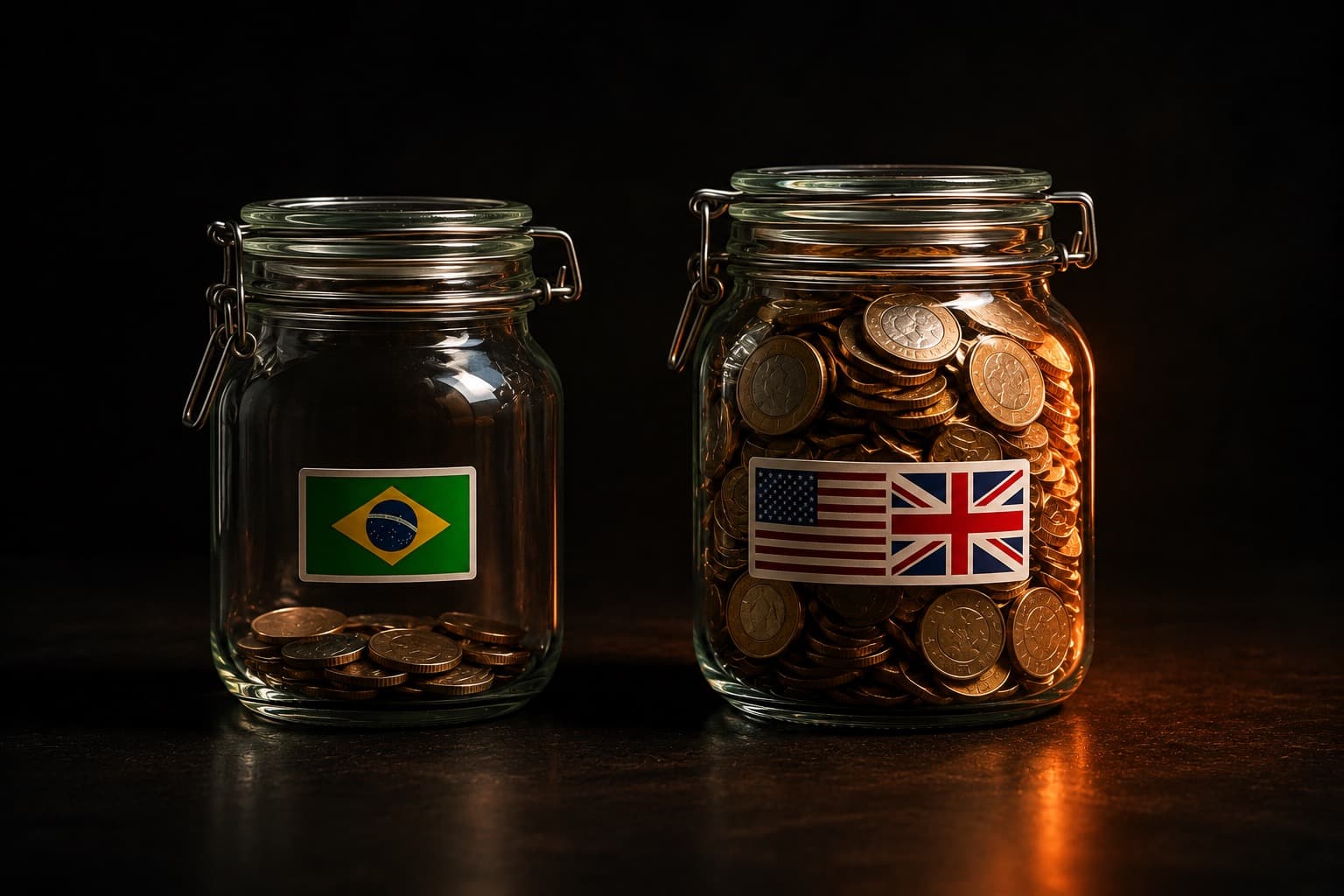
- Geography matters a lot — a Brazilian audience has a CPM of ~$1, versus ~$6.50 in the UK and similar levels in the US — a typical 4-to-7× gap (figures from market analysts like vidIQ; YouTube doesn't publish official CPM by country). It's pure ad-auction economics: the advertiser pays more to reach people with more disposable income.
- Niche matters just as much — finance and business (B2B) pay ~10× more than gaming or entertainment, because a financial-services advertiser pays a fortune to reach the person who makes a big purchase decision. Volume without a niche pays little.
- The honest number — 100,000 views/month from a low-CPM audience (e.g., Brazil) = realistically $30–150. It's not a salary, it's a supplement. The SAME view count from a US audience would pay something like $300–500 (and, in a finance niche, $1,200–2,500) — which is exactly why the audience matters as much as the view count.
- Watch out for the exchange-rate effect (if you get paid in a weak currency) — AdSense pays in dollars — if you convert to a devalued currency, $1 becomes a bigger local number, and that number looks larger than the real economic value behind it. A big number in the local currency isn't the same as a valuable audience.
The tax side of this money — opening a company to pay less tax, the W-8BEN so you don't lose 30% to US withholding, and the local small-business regimes — is explained in detail in our accounting for creators guide.
4. Shorts: how the pool works
Since February 2023, Shorts don't pay per video. The revenue from the ads that run between Shorts forms a monthly pool, and you receive a slice of it:
- The pool is per country — revenue is distributed by your share of the total engaged views of monetized Shorts, within each country. 5% of eligible views ≈ 5% of that country's pool.
- You keep 45% — of your allocated share — with or without music.
- The music gotcha — using music in YOUR Short does NOT cut your 45% share. The licensing deduction happens when revenue ENTERS the pool (a Short with no music puts 100% into the pool; with 1 track, 50%; with 2+, 33%). It's an ecosystem effect, not a fine on your video.
5. What takes away (or never turns on) your monetization
- Reused content — reposting other people's material without real transformation (your commentary, your editing, you on camera) demonetizes the WHOLE CHANNEL, not just one video. Reactions and compilations sit in the gray zone: they only pass when there's genuinely significant transformation.
- “Inauthentic” content — a rule tightened in July 2025 targeting mass-produced, templated, low-effort content — YouTube's direct response to the flood of repetitive AI videos. Not disclosing AI use in Studio can also catch you out.
- Not advertiser-friendly — heavy profanity, violence, sensitive topics → limited ads (the yellow icon). Here it's demonetization of the VIDEO, not the channel.
6. The trick of the trade: quality pays more than settings
If you made it this far hoping for the settings trick that multiplies revenue, the truth is simpler — and more powerful: what moves your monetization most is retention, that is, how long people watch. And retention is, at heart, production quality: script, pacing, editing, audio.

High retention multiplies revenue down three paths at once:
- More ads seen — someone who watches 60% of a video sees 2 to 3× more ads than someone who watches 30%. On a 15-minute video, going from 40% to 80% retention opens every ad break instead of just the one at the start.
- Higher CPM — advertisers pay 40% to 80% more for videos with a high completion rate — they know the ad will actually be seen.
- More reach from the algorithm — videos above 50% retention get 2 to 4× more impressions. The 2026 algorithm is, at its core, an engine trying to predict satisfaction — and the strongest signal it has is how long people stayed.
The compounding effect is big: in the same niche, videos with 65–75% retention earn an RPM of ~$8–12 versus ~$3–5 for those below 35% — about 2.4× from retention alone, before any reach gain. And there's the layer worth even more: only ~34% of creators live off ads; the ones who really earn diversify into sponsorships (10 to 100× AdSense), products and services — and none of that happens on a channel that doesn't hold its audience.
Quick questions
How many subscribers do I need to monetize on YouTube?
It depends on what you want to turn on. With 500 subscribers (plus 3 videos in the last 90 days and 3,000 watch hours OR 3 million Shorts views) you unlock the fan features: memberships, Super Thanks and Shopping. To actually earn from ADS, the bar is 1,000 subscribers plus 4,000 watch hours in 12 months (or 10 million Shorts views in 90 days).
How much does YouTube pay per 1,000 views?
There's no fixed number — anyone promising you an exact rate is selling an illusion. What does exist is RPM (how much YOU pocket per 1,000 views, after YouTube's cut and the fact that not every view shows an ad). And it varies wildly with your audience's geography: 100,000 views/month from a low-CPM audience (like Brazil, ~$30–150) versus a US/UK audience, which can pay 5 to 25× more. In a high-value niche (finance/business), it multiplies again.
Why do I earn so little when I have so many views?
Three reasons: (1) audience geography — markets like Brazil and India have a CPM ~4 to 7× lower than the US/UK; (2) only 40% to 60% of views show an ad (Premium viewers, ad blockers, non-advertiser-friendly videos, views too short); (3) the niche matters — finance pays ~10× more than gaming at the same view count.
Does YouTube keep 45% of everything?
No — it depends on the surface. On long-form video ads you keep 55% (YouTube 45%). On memberships, Super Chat and Super Thanks you keep 70%. On Shorts you keep 45% of the pool. Generalizing it to “45%” is just wrong.
How does Shorts monetization work?
Differently from long-form: there's no per-video payout. Ad revenue from between Shorts forms a monthly pool, split by your share of engaged views (per country), and you keep 45%. Using music in YOUR Short doesn't cut your share — the music deduction happens when revenue enters the pool, at the ecosystem level.
When does Google pay me? Is there a minimum?
Yes: AdSense only pays once your balance passes $100 (it rolls over month to month until then). Once you clear that threshold with no holds, payment is issued between the 21st and 26th, landing by bank transfer (EFT) within a few business days. Before your first payment you have to verify your address and identity.
Will a copyright notice (Content ID) take down my channel?
Don't confuse the two. A Content ID claim is automatic and is NOT a penalty: it usually just redirects that video's revenue to the music owner. A copyright STRIKE is a different thing — it's a legal removal, counts at the channel level, and 3 strikes in 90 days end the account. Disputing a claim without a valid reason can actually turn into a strike.
Can I make a living from AdSense?
For the vast majority, no — and that's the honest truth. Only about 34% of creators have ads as their main income; the real money is in sponsorships (which pay 10 to 100× more), products and services. The channel is rarely the revenue source: it's the brand asset that unlocks the revenue sources. And what sustains all of it is the quality that holds the viewer.
Sources
- YouTube Partner Program — eligibility (YouTube Help) — the official requirements for both tiers.
- RPM and CPM — official definitions (YouTube Help) — what each metric means and how they differ.
- Shorts monetization policies (YouTube Help) — how the 45% pool and the music deduction work.
- Understand copyright strikes (YouTube Help) — the difference between a Content ID claim and a strike.
- AdSense payment thresholds (AdSense Help) — the $100 minimum and the payment cycle.
Understanding monetization takes the weight off the question “is it even worth it?”. The honest answer: AdSense is the supplement — what builds real revenue is a channel that holds its audience and opens the door to sponsorships and products. While you handle the tax side and the retention of the first few seconds and the packaging that wins the click, the part about turning your footage into a video that looks like a premium product is on HEY JOE. And if the goal is to earn beyond ads, a brand video or VSL is what turns an audience into customers.