Editing & post-production
Copyright & free assets: the practical guide
“I found it on Google, can I use it?” — almost always, no. But there's a ton of genuinely free material out there, if you know how to read the license. The catch is that “free” isn't one single thing: understanding the difference protects you (and your client) from getting a strike — or a lawsuit. Here's all of it, in plain English and with examples.
~20 min read
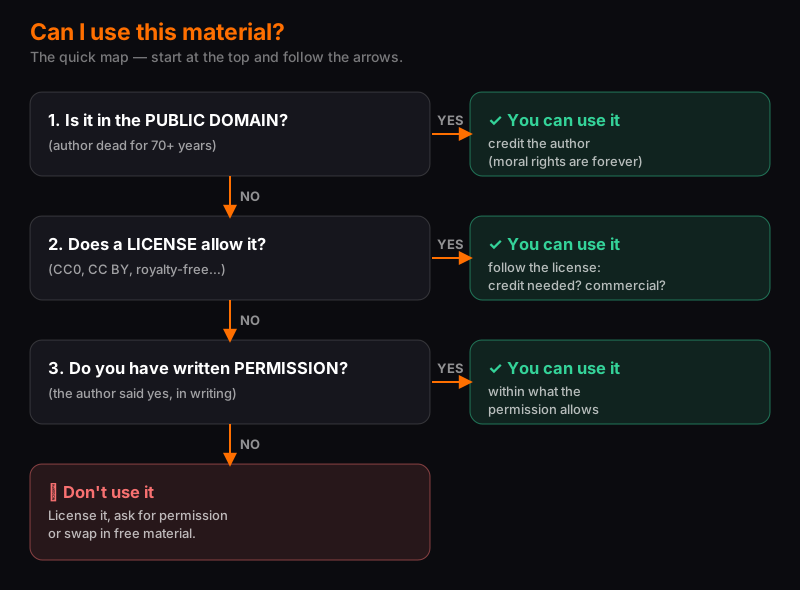
By default, every work is born protected by copyright — photo, music, video, illustration, font. You don't have to register anything. There are only three safe ways to use someone else's work: it's in the public domain, it carries a license that permits your use, or you have written permission. “I found it online” is none of the three. This map sums up the entire decision — the rest of the guide explains each box:
1. The kinds of “free” (and what each one means)
“Free” comes in several flavors, and they're not the same thing. Before you download anything, know which is which:
- Public domain — protection has expired — fully free use, including selling. In Brazil, 70 years from January 1st of the year after the author's death. The term VARIES by country (thanks to the Berne Convention, the basics are similar worldwide, but the duration differs — in the US and most of the EU it's usually life + 70 years, in other countries, less): check by the work's country of origin. Example: a piece by Beethoven, a short story by Machado de Assis. (Even so, credit the author and don't distort the work — moral rights last forever.)
- Creative Commons (CC) — this is NOT “free, no rules.” It's a set of ready-made licenses the author themselves chooses to spell out, in advance, what you're allowed to do. That's why “it's CC” on its own means nothing — it depends on the letters (CC0, BY, NC… see §3). Example: a photo marked “CC BY” on Flickr you can use, even commercially, as long as you credit it.
- Royalty-free — a “royalty” is the money paid to the author for EACH use. “Royalty-free” means you do NOT pay per use — you pay once (or nothing) and use it as many times as you like. It doesn't mean “free” or “no owner”; and, contrary to what a lot of people think, it almost always ALLOWS commercial use. Example: you subscribe to a music library and use the tracks in your videos without paying per play.
- “Free for personal use” — free only for a personal project, not for making money. Client video, an ad or a monetized channel = off-limits. It's the most common trap in fonts, icons and PNGs.
- “Free for educational use” — free only for non-profit teaching (a class, school material). A PAID course of yours, or a monetized “tutorial” video, does NOT count — despite the “educational” name.
2. What “commercial use” means (the part that trips everyone up)
Almost every license revolves around this word — and almost everyone gets it wrong. “Commercial” doesn't mean “selling the file.” It means using the work in a context that makes (or could make) money.
- It is commercial use — client video, paid ad, monetized channel, paid course, brand post, the intro for a product on sale. If there's money involved in the project, it's commercial.
- It isn't commercial use — a personal video with no monetization, a school project, a portfolio that sells nothing. This is where “free for personal use” fits.
- The royalty mix-up — royalty-free almost always ALLOWS commercial use: you use the track in the client's video and don't pay per play. What forbids making money is the NC (non-commercial) tag, not royalty-free.
- The flip side — almost no license lets you RESELL the raw file. Using it in a piece ≠ reselling the file.
- ✅ I downloaded a photo on Pexels and put it in a client's video — allowed (royalty-free, no credit).
- ✅ Selling the finished video that uses that photo — allowed (you're selling YOUR work, not the photo).
- ✅ CC0 music under a paid ad — allowed (CC0 permits commercial use).
- ⚠️ A CC BY photo in a client's video — allowed, but you MUST credit the author.
- ❌ A CC BY-NC photo/song in a monetized video — not allowed (NC = non-profit only).
- ❌ Taking the photo you downloaded and reselling it in a photo pack — not allowed (reselling the raw file).
3. Creative Commons licenses in practice
Now that you know what CC is, here's what each combination unlocks (from most open to most locked down):
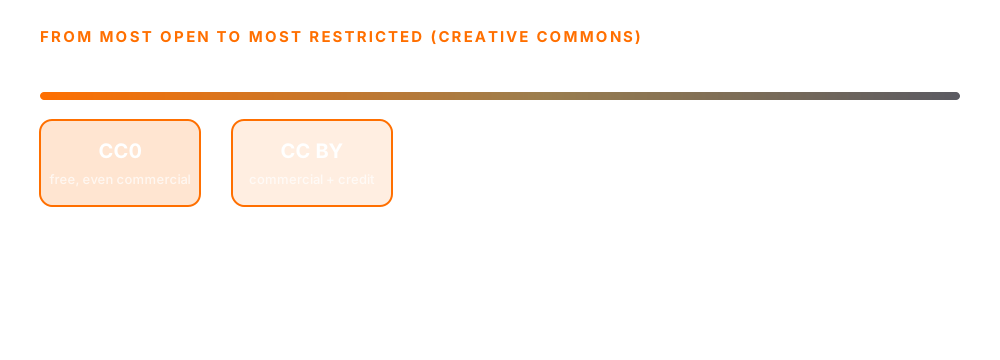
- CC0 — the author gives up everything. Free use for any purpose, including commercial, with no required credit. The most permissive — ideal for a client. In practice, it's the same as “rights-free.”
- CC BY — free use, including commercial, AS LONG AS you credit the author. Great for commercial video; just don't forget the credit line.
- CC BY-SA — commercial + credit, BUT whatever you create from it inherits the same license (a “viral”/contagious effect). Be careful in a client piece.
- CC BY-NC — non-commercial use only, with credit. No good for client video, ads or monetized content.
- CC BY-ND — allows even commercial use and with credit, but WITHOUT altering it (you can't trim, edit or remix). For video editing, almost always a non-starter.
License CC BY 4.0 (creativecommons.org/licenses/by/4.0). No modifications.
4. Is altering it enough to make it “my work”?
The most common question: “if I edit it heavily, does it become mine?” Almost always, no. Touching a protected work creates a derivative work — and a derivative needs permission (or a license that already allows it: CC BY permits, CC ND forbids). What decides whether it became something new and yours is a single principle:
- Copyright protects the EXPRESSION, not the idea — you can freely reuse the idea, the style, the technique, the trend. What you can't do is copy THAT photo, THAT track, THAT scene. Inspiration ≠ copying.
- There's no magic percentage — “I changed 30%” protects nothing — no law anywhere sets a percentage. What matters is whether the recognizable expression of the original work is still there.
- “Transformative” doesn't make you the owner — in the US, “transformative” is only a fair use defense argument — it doesn't transfer ownership (the Warhol v. Goldsmith case made that clear). In Brazil, not even that exists.
In practice, by medium:
- Image — applying a filter/preset, cropping or recoloring someone's photo — or TRACING it into an “illustration” — is a derivative and needs permission. But YOUR own photo in the style of a famous photographer = a new work (style isn't protected).
- Audio — a remix uses the master; re-recording the melody (interpolation) uses the composition — both need a license. But a song in the same genre/mood, with your own melody and lyrics = a new work.
- Video — a re-edit, supercut or compilation of someone else's clips = a derivative of each clip. But your own footage on the same topic/trend = a new work.
5. Quotation, parody and “fair use” around the world
You may have heard “you can use a little bit,” “if it's criticism it's free” or “it's just a parody.” Careful: this depends on the country, and it's almost always narrower than it sounds. The honest summary:
- 🇧🇷 Brazil — there's no “fair use” — the law has a CLOSED LIST of exceptions. Quotation: you may reproduce PASSAGES for study, criticism or debate, citing author and source (not “the whole work because I commented on it”). Parody: free if it isn't a copy and doesn't disparage the original. Outside the list, you need permission.
- 🇺🇸 US — flexible (and unpredictable) “fair use” — a 4-factor test (purpose/whether it's “transformative,” the nature of the work, how much you used, and the effect on the market) decided by a JUDGE, case by case. It favors criticism, commentary, parody, news and teaching — but “I gave credit” and “I used X seconds” are NOT rules. You only “win” fair use if you get sued and the judge agrees.
- 🇪🇺 European Union (and the UK, Spain, Portugal) — also NO fair use — a closed list of exceptions. It has the right of QUOTATION (criticism/review, citing the source) and the PARODY/caricature exception (the Deckmyn case settled it: a parody must evoke the work, be clearly different and be humorous). Since 2019, YouTube/TikTok have to respect a user's quotation and parody.
- 🇧🇷 Brazil: infringement. There's no “fair use” and no seconds limit; it can mean a YouTube claim and a damages lawsuit.
- 🇺🇸 US: almost certainly NOT fair use — the song is the “heart” of the work and replaces a license you would have paid for. Likely result: claim/strike.
- 🇪🇺 EU: no fair use; 15s of a soundtrack doesn't fit quotation or parody → infringement.
Quotation in practice is showing a short clip of a film in a genuine review video, commenting on that scene — not uploading the whole scene without analyzing it. Parody in practice is re-recording the melody of a famous song with new comic lyrics, clearly different and for a laugh — not using the original song intact as a soundtrack.
6. Where to find free material (table by license type)
Reliable, live sources (checked in 2026). The License column tells you what to expect from each — and the golden rule still stands: check the license on each file, because the same site can mix types.
| Source | License | What's there / watch out for |
|---|---|---|
| Smithsonian, Met Museum, Rijksmuseum | Rights-free | Art and collections in CC0, high resolution — anything goes, no credit. |
| Poly Haven, Quaternius, Kenney | Rights-free | 3D, HDRI, textures and assets — all CC0, no credit. |
| Public Domain Vectors, Heroicons, Tabler, Lucide | Rights-free | Vectors and icons with no credit (CC0 / MIT). |
| Google Fonts, Domínio Público (MEC), WikiFlix | Rights-free | Free fonts; Brazilian collections and public-domain films. |
| Pexels, Unsplash, Pixabay | Royalty-free | Photos — commercial use, no credit. Just don't resell the photo unaltered. |
| Mixkit, Pexels Videos, Pixabay Videos | Royalty-free | Video / footage — commercial use, no credit. |
| YouTube Audio Library, Pixabay Music | Royalty-free | Music — commercial use, no credit. |
| Coverr | Credit required | Video — the free plan REQUIRES credit (only the paid one removes it). |
| Zapsplat, Incompetech, Chosic | Credit required | Sound effects and music — generally require credit (and a free account). |
| Flaticon, Font Awesome | Credit required | Icons — the free tier requires visible credit. |
| Openverse, Wikimedia Commons, Freesound, SVG Repo | License per file | CC / per-file search — check the license on each item (on Freesound, filter by CC0). |
| Internet Archive | License per file | ⚠️ NOT all public domain — only use the item whose rights field confirms it. |
Watch out for traps: “free PNG” sites tend to have a mixed license or “personal only”; “free” libraries sometimes release only the low resolution for non-commercial use. When in doubt, prefer rights-free / CC0.
7. What about AI-generated images (and art)?
Tools like Midjourney, DALL-E, Firefly and Canva generate art fast and cheap — and the topic is everywhere right now. But for client work there are rules that change everything:
- A 100% AI image has no owner — not in the US, not in Brazil — the law requires a human author (the Thaler case, in the US, settled this). In practice: you (and your client) CAN'T stop someone else from copying that image. Good for a draft, a texture or a background; think twice about a brand's signature image.
- Real editing changes the game — what CAN have protection is your human contribution — composition, layout, creative retouching on top. The more real human work, the more defensible. Keep the project files as proof of authorship.
- The terms vary — and protection costs — most allow commercial use only on the PAID plan (on Midjourney, a high-revenue company needs the Pro plan). And only Adobe Firefly, Getty and Canva Enterprise offer indemnification (they cover you if the image steps on a third party's rights). Open models (Stable Diffusion) put all the risk on you.
- Never generate recognizable “IP” — a brand character, a logo, a real person's face or “in the style of [living artist].” That's exactly where the lawsuits live — it becomes a copyright/trademark case, with or without AI.
- Label it when you publish — YouTube, TikTok and Instagram now REQUIRE a disclosure for realistic synthetic content (2026). Delivered to the client? Put “is this AI?” on the checklist.
- Free library ≠ a clean AI image — some libraries (like Pixabay) now accept AI images, labeled — so the “license” you get gives you neither copyright nor any guarantee the image didn't copy something protected. Getty solved it by selling its own “safe” generator, with indemnification; libraries like Pexels don't accept AI.
8. Precautions that save you headaches
- Check the license on EVERY file — CC0, CC BY and even CC BY-NC live side by side on the same site. The “license type” is on the file's page — read it before you download.
- Keep the credit (and the receipt) — when the license asks for attribution, copy the exact line (TASL format) into the video description. On a paid source, keep the certificate/invoice — that's what lets you dispute a claim later.
- People and brands — a free library rarely guarantees a model release. Avoid recognizable faces and brands in an ad or a sensitive piece.
- Steer clear of a sketchy site — a strange domain, too many ads, redirects or a vague license = risk. Prefer well-known, well-documented sources.
9. Myths that cost you dearly
- “I can use up to 10 (or 30) seconds.” — there's no safe number of seconds anywhere. A short clip used without permission already infringes. That “magic number” is a myth — not even American fair use recognizes it.
- “If I give credit, I can use it.” — credit is NOT a license. Citing the author is required in the cases that are already allowed — but on its own, it authorizes nothing.
- “It's educational / non-profit, so it's free.” — no. “Non-profit” and “educational” are not a blanket exception — not in Brazil, not in the EU. A public YouTube video doesn't qualify, even without making money.
- “It's on the internet, so it's free.” — being available frees up nothing. Protection is automatic and lasts the whole term; “public” doesn't mean “public domain.”
- “I edited / changed about 10%, so it's mine now.” — no. Altering creates a derivative work — and a derivative also needs permission. There's no percentage that “launders” someone else's work.
- “I bought the song, so I can put it in my video.” — buying the copy isn't buying the right to sync it into a video. Inserting it into an audiovisual production is a use that needs its own permission.
- “In the US it's fair use, so I'm covered.” — fair use is a courtroom defense, decided case by case AFTER the fact, and it doesn't exist in Brazil or the EU. It's not a “cleared” stamp.
Quick questions
Can I use an image I found on Google?
Almost never. Google is a search engine, not a free library — it only finds images that belong to other people. Use libraries with a clear license (see the table) and check the license on each file.
If I give credit, can I use anything?
No. Credit isn't permission. Citing the author is required in the cases that are already allowed, but on its own it authorizes nothing. Without a license, crediting is still an infringement.
Can I use 10 or 30 seconds of a song without a license?
There's no safe number of seconds anywhere in the world. Music in a video needs a license (sync). That “magic number” is a myth.
Is an AI-generated image mine?
A 100% AI image has no owner — not in the US, not in Brazil — because the law requires a human author. In practice, anyone can copy your AI image.
Can I sell a video that uses royalty-free music or photos?
Yes. You're selling your video (your work), not the file. What you can't do is resell the raw file (the photo or the track) on your own.
I edited it heavily — did it become my work?
Not necessarily. If the original expression is still recognizable, it's still a derivative work and needs permission. There's no percentage that turns someone else's work into yours.
Is “public domain” the same as “it's free on the internet”?
No. Public domain is when protection has expired (in Brazil, 70 years after the author's death). Being available on the internet frees up nothing.
Sources
- Creative Commons — About CC Licenses (official) — what each license permits.
- Planalto — Law 9.610/98 (LDA) — Brazil's copyright law (arts. 8, 29, 41, 46, 47, 48).
- U.S. Copyright Office — Fair Use Index — the 4 factors of American fair use, in official text.
- EUR-Lex — Directive (EU) 2019/790 (DSM) — the quotation and parody exceptions in the European Union.
- U.S. Copyright Office — Copyright & Artificial Intelligence — why a 100% AI work isn't protected (it requires a human author).
- LicenseOrg — Free stock photo licensing traps — the gotchas of Unsplash/Pexels/Pixabay.
Music, footage and art under the right license are part of every delivery from HEY JOE — including original music, when the project calls for an identity of its own. See also music with no Content ID and special effects without blowing the budget.