The creator's business
Why every content creator needs an accountant
Creator income is taxable income — there's no such thing as “it's just internet money.” And here lies one of the biggest mistakes people make as they grow: staying a private individual paying up to 27.5% when, as a company, the tax starts at 6%. A good accountant isn't a cost — it's profit.
~9 min read

1. Creator taxes: individual vs. company
AdSense, monetization, course sales, sponsored posts — in Brazil, all of it is taxable income. The difference is in how you receive it:
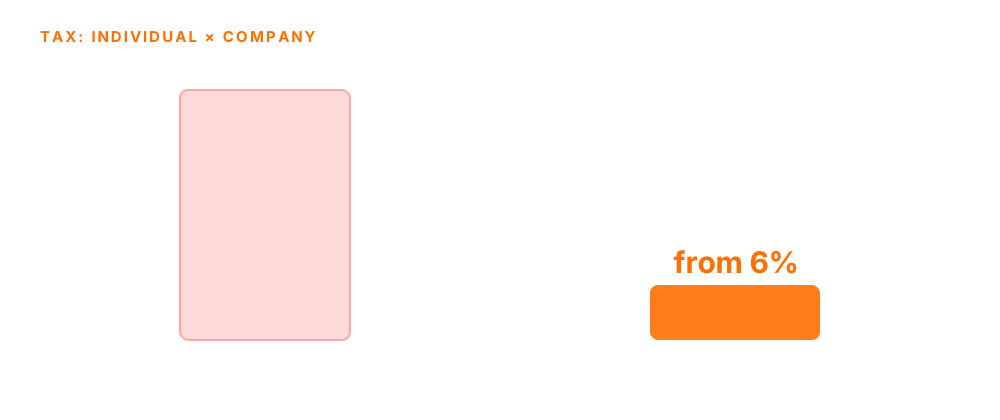
- As an individual (CPF) — AdSense lands in your personal account and you owe income tax every month (Carnê-Leão), on a scale that reaches 27.5% — and you may also owe social security (INSS) on that same income (an individual contribution of up to 20%). To make it worse, you can barely deduct your costs (editing, gear, software).
- As a company (CNPJ) — the same income is usually taxed at roughly 6% to 19.5%, starting at 6% under Simples Nacional (Annex III) for content production. That's why a profitable creator pays far less as a company.
- And you get to deduct costs — as a company you write off legitimate business expenses and keep personal money separate from professional money — which also tidies up your tax return.
Rule of thumb: once your monthly creator income is consistently in the thousands, staying an individual means paying extra tax by choice — the savings usually dwarf the accountant's fee.
2. MEI, Simples Nacional, and the right business code

A quick gloss for the international reader: in Brazil, MEI is the simplest one-person business tier; Simples Nacional is the unified small-business tax regime; the CNAE is your official business-activity code; and Fator R is the payroll-ratio rule that decides which tax bracket you land in. Here's how they play together:
- The MEI cap (2026) — R$81,000 PER YEAR — an average of about R$6,750/month, but what counts is the annual total. Plenty of full-time creators blow past that yearly cap in a good year, and going over with no warning becomes a retroactive headache.
- The next step up — usually a micro-company as a single-member LLC (no partner), under Simples Nacional — with your personal assets better protected.
- The right business code matters a lot — the digital-content-provider code (6319-4/00) and the advertising codes fall under Annex III, starting at 6% — but heads-up: they only get that low rate when payroll/owner's draw is ≥28% of revenue (that's the Fator R rule). Below that, they start at 15.5% (Annex V). The wrong code makes you pay more for the same work, and the right one depends on your exact activity — always confirm it with your accountant.
- Fator R — the rule that lets you move from the heavier Annex V to Annex III when payroll/owner's draw is ≥28% of revenue. Pure planning — this is where a specialized accountant pays for themselves.

Opening your company with the right code and regime from day one avoids rework and tax paid for nothing — exactly the kind of thing an accountant who specializes in creators sorts out fast. Tactus, for example, opens the company under the right classification and even migrates people who already have a company set up with another accountant.
3. A virtual office: the registered address for working from home
A virtual office is a real commercial address you rent purely to register and maintain your company, without renting a physical room. For a creator, it solves three things:
- Privacy (the big one) — if you register the company at home, your RESIDENTIAL address becomes public at the tax authority and is easy to find. For a public figure, that's a real safety risk. A virtual office keeps your home private.
- Cost — it swaps rent, property tax, building fees, and utilities for a fixed monthly fee — usually tens of reais, not thousands.
- Compliance — an address recognized by the tax authority and the trade board, accepted by banks, that also receives your official mail and notices (with an email/WhatsApp alert).

One detail: a virtual office fits anyone providing a service (a creator qualifies). The real restriction is for activities that require a physical presence or inventory at the address — not e-commerce itself.
Many digital accounting firms already bundle this in: Tactus, for example, offers a free virtual office to its clients — you keep your company in good standing without exposing your home address and without paying a separate monthly fee.
4. What to look for in an accountant for a digital business
- Digital specialization — someone who already works with YouTubers, course sellers, and affiliates — not a generalist who treats AdSense as a mystery.
- Knows how to handle income from abroad — AdSense and course platforms pay in foreign currency; your accountant needs to bring that into the company and tax it correctly.
- Planning, not just bookkeeping — regime, business code, and Fator R offered up front — that's where the money is saved.
- Watches your limits — warns you BEFORE you blow past the MEI cap or a Simples bracket, instead of reclassifying you retroactively.
- A real accountant + 100% online — access to an actual person (WhatsApp/video), with everything handled remotely: opening the company, switching accountants, running the day-to-day.

5. What if you create from outside Brazil?
Everything above is the Brazilian reality. If you live elsewhere — the US, Europe, anywhere — the logic is the same (creator income is taxable income, and getting it organized is what lets you sleep at night), but the rules change by country. Here's a quick pass; the honest advice is always to find a local accountant who understands digital income.
- You're a business, not a hobby — in most countries, only people who treat the channel as a real business (separate account, registration, books) get to deduct their costs. Mixing personal and work money complicates everything.
- United States — creators usually start as a sole proprietor; you report on Schedule C and pay self-employment tax (~15.3%) yourself, in quarterly installments. Brands pay via a 1099-NEC — but the income is taxable even if no form ever shows up.
- Europe / United Kingdom — you typically register as self-employed (in the UK, a “sole trader” + Self Assessment) and, above a revenue threshold, VAT kicks in (in the UK, £90k). In Germany, creators usually fall under the Gewerbe regime — case by case with a local accountant.
- The tax that hits EVERY YouTuber — since 2021, Google withholds US tax on the share of your revenue from viewers watching in the US. Filing the W-8BEN form caps that withholding; skip it and you can lose up to 24% on your worldwide total.
- Keep everything, for years — invoices, receipts, statements (US ~3 years, UK ~5). That's what protects you in an audit, in any country.
6. Handled the tax? Now handle the product
Sorting out the tax side frees your head for the one thing no one does for you: creating. And when it comes to turning raw footage into a video (or an online course) that looks like a premium product, that part is on HEY JOE — editing that holds the viewer, cuts refunds, and justifies your price.
Quick questions
When is it worth leaving sole-individual status and opening a company?
Once your creator income is consistently in the thousands per month. In Brazil, as an individual you pay up to 27.5% income tax (and you may still owe social security); as a company, the tax starts at 6%. The savings usually dwarf the accountant's fee — staying a private individual becomes paying extra tax by choice.
Do I need a registered company to get paid by AdSense or a course platform?
You can get paid as an individual, but you pay more tax and can barely deduct your costs. With recurring income, a company under the right classification (in Brazil, Simples Nacional, Annex III) cuts the burden a lot and also keeps your foreign-currency money organized.
Is MEI a good fit for a content creator?
It works at the start, but the cap is R$81,000 PER YEAR (an average of about R$6,750/month). A full-time creator blows past it fast — and going over without planning turns into a retroactive bill. The usual next step is a micro-company under Simples Nacional.
How is income from abroad (AdSense, foreign platforms) taxed?
It's taxable income, and it has to flow into the company and be taxed correctly. An accountant who understands foreign-currency income handles the exchange and the classification so you don't get a nasty surprise at filing time.
Can I register the company at my home address?
You can, but your home address becomes public at the tax authority — a real safety risk for a public figure. A virtual office address solves this for a low monthly fee while keeping your home private.
Does the accountant need to be in my city?
No. These days you can open a company, switch accountants, and run everything 100% online, with support over WhatsApp and video. What matters is specialization in digital business, not location.
Is the MEI cap going to rise?
There are bills in Congress to raise the cap (the furthest along floats somewhere between R$130k and ~R$145k/year, with others proposing up to R$150k), but as of mid-2026 nothing has passed: the cap is still R$81,000 and, if it changes, it's expected to take effect only in 2027. Plan with today's number.
I live outside Brazil — do I still need an accountant?
Yes. Creator income is taxable everywhere; what changes are the rules (in the US, self-employment tax and Schedule C; in the UK, sole trader and Self Assessment). And every YouTuber in the world should file the W-8BEN to avoid up to 24% withholding from Google. The best path is a local accountant who understands digital income.
Sources
- Simples Nacional for content creators (Annexes, Fator R) 2026 — rates and rules for creators.
- Taxes for YouTubers (AdSense) — Monetizei — how tax on AdSense works.
- MEI cap 2026 — Contabilizei — revenue cap and what happens when you exceed it.
- Virtual tax address: how it works — Contabilix — the advantages of a virtual office.
Getting the tax right frees up your time and your money for what matters: creating. While you organize the tax and the legal side (music and image rights), the part about turning raw footage into a premium product is on HEY JOE — especially if you sell online courses.