Grow on YouTube
YouTube Shorts strategy: the first second is everything
Shorts looks like the easiest format in the world — and that's exactly why almost everyone gets it wrong. It doesn't work like long-form video: it's a feed that pushes, where nobody clicks on anything and your video lives or dies in the first second. Understanding that difference changes how you record, edit and think about every Short.
~10 min read

1. Shorts is a different game: the feed PUSHES
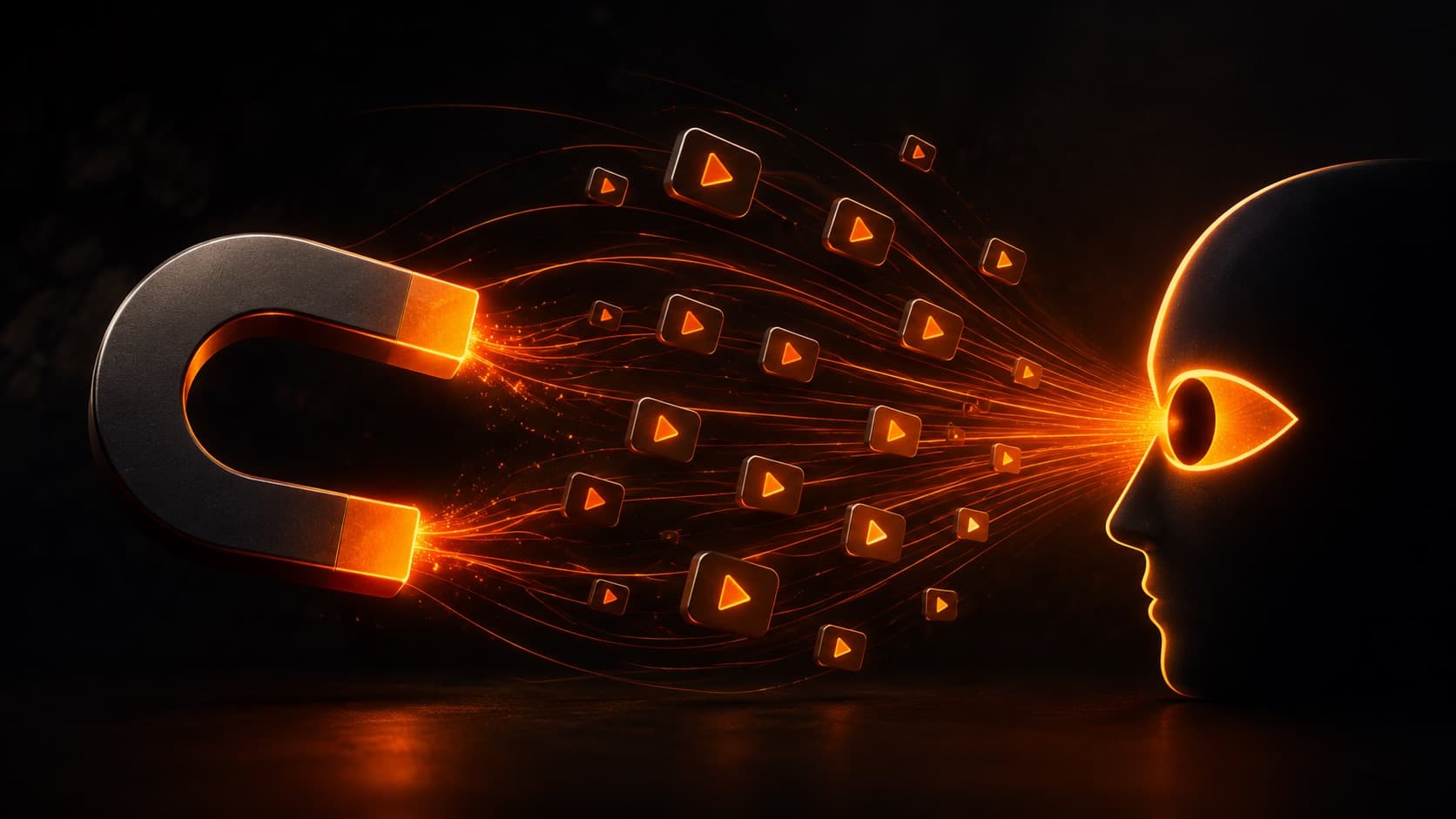
With long-form video, a person sees a thumbnail and decides to click. On Shorts, that decision doesn't exist: the video is injected into the feed and the system watches what they do in the first instants. That's why the most important signal is the swipe-away — how fast a person swipes off.

- The master signal — “watched vs. swiped” in the first 1–3 seconds. The largest public study (Paddy Galloway, 3.3B views — community data, not official) points to a 70–90% retention band as the engine of distribution.
- Metadata matters LESS — since there's no click to influence, the title/thumbnail/tags count for much less than in long-form. The hook does its work before the metadata ever kicks in.
- Niche beats broad — the feed tests on a cold audience; a niche gives a clean signal of “who to show it to next.” A clip that's lukewarm for everyone loses to the clip that grips a specific audience.
- Fast test — the Short is seeded in a small test; if it doesn't clear a threshold in the first ~30–60 min, distribution all but stops (community estimate).
Why “push, not pull” is the whole story in the algorithm guide — Shorts is a recommendation model entirely separate from long-form video.
2. The craft of a Short that holds
- The first second is the whole game — open with the point, not with “hey guys.” If the person has no reason to stay at second 1, there is no second 2.
- 9:16, no letterbox — truly vertical, and respect the safe zone — the interface (captions, buttons) covers the right side and the bottom.
- Captions are infrastructure, not decoration — a lot of people watch on MUTE. Burned-in captions carry the payoff; 5–7 words per line, two lines max.
- Tight cuts, no dead air — every frame has to justify the next one. Kill the “warm-up intro.”
- Loops — an ending that stitches into the opening manufactures replays — and replays count. Design the last frame to flow into the first.
- Length: the sweet spot flipped — 40–60s with steady retention tends to beat the under-10s ones. But only if it holds — length is permission, not a cheat code.
3. Trends, music and the reused-content wall
- Trending audio helps discovery — it gives the system a familiar “bucket” to slot you into. The sound library in the Shorts app is self-licensed for Shorts up to 60s.
- The “inauthentic” wall — since July 2025 YouTube tightened up: reused content (reposted with no real transformation) and mass-produced/templated content is ineligible for monetization. Reposting other people's trends is a dead end.
- Watermarks (the honest take) — YouTube does NOT publish a “I penalize watermarks” rule. But a competitor's watermark makes the video LOOK reposted — and looking-reused is ineligible under policy. Export clean, always.
4. The bridge: using Shorts as a funnel (without the myth)
Because the systems are separate, a viral Short won't boost your long-form video on its own. The value of Shorts→long-form is a funnel you build on purpose:

- 1 long-form → several Shorts — mine the long-form video for standalone moments (a strong statement, a before/after, a stat, a joke) and cut each one as an independent Short, with its own hook.
- What works — a pinned comment with a SPECIFIC call (“watch the full breakdown,” not “subscribe”), an end screen and a matching topic. Creators report real long-form discovery gains (industry data, not an official study).
- What does NOT work — a loose Short with no bridge; a generic “subscribe” CTA; and assuming a viral hit pulls the long-form along automatically. Subscribers coming from a Short convert less — the funnel needs design.
Cutting one recording into several standalone Shorts — each with its own hook, context, captions and clean export — is a craft of its own. The full step-by-step (and how to go beyond Shorts: clip, carousel, blog, podcast) is in the guide 1 recording, 10 pieces of content.
5. How much Shorts pays (in short)
The ad revenue between Shorts forms a monthly pool, split by your share of engaged views, and you keep 45%. Since March 2025 the public counter counts replays, but monetization runs on engaged views — a big view count ≠ a proportional payout. The full breakdown (eligibility, RPM, the music math) is in the monetization and AdSense guide.
6. The trick of the trade: you don't have a Shorts problem
You have a first-second problem — and that's editing. Every frame of a Short fights against the thumb; the audience is cold, on mute, scrolling. Engineering a hook that survives that, with captions, pacing and a loop, is a craft. And turning one recording into a batch of genuinely standalone Shorts (each with its own hook, loop, clean export and call back to the channel) is production discipline — repeatable and high-leverage.
Quick questions
Does a short Short beat a long Short?
Not anymore. The old “shorter is always better” rule flipped: the largest public study (Paddy Galloway, 5,400 Shorts / 3.3 billion views — community data, not an official YouTube number) found that 40–60s Shorts, when they hold attention, beat the under-10s ones by a wide margin. But it's conditional — a 55s Short with retention falling apart loses to a tight 20s one. Length is permission, not a shortcut.
Why won't my Short take off?
Almost always it's the opening. Shorts is a feed that PUSHES — nobody clicks a thumbnail, the video gets injected and the system measures what you do in the first few seconds. The master signal is the swipe-away. If most people swipe away in the first second, YouTube stops distributing it. The opening hook decides almost everything.
Does one viral Short boost my long-form videos?
Not automatically — that's the biggest myth. Shorts and long-form videos have separate recommendation systems (they've been decoupled since around 2025). A strong Short only pulls the long-form along if you BUILD the bridge: a pinned comment with a specific call (“watch the full video”), an end screen, a matching topic. Without that, you're left with high views and zero channel growth.
Can I repost my TikToks/Reels as Shorts?
You can upload them, but export them CLEAN (no TikTok/Reels watermark). YouTube doesn't publish a rule saying “I penalize watermarks,” but content that LOOKS reposted from another platform risks being flagged as “reused/inauthentic content,” which is ineligible for monetization under official policy. A watermark makes even your own video look like a cross-post.
Does using a trending song cause rights problems?
It's partly a myth: the trending sound library inside the Shorts app itself is self-licensed for Shorts up to 60s. Trending audio still helps discovery (it gives the system a familiar “bucket”). The thing to watch is music from outside that library, which can trigger Content ID.
How much do I earn from Shorts?
The ad revenue between Shorts forms a monthly pool, distributed by your share of engaged views, and you keep 45%. Important detail: since March 2025 the public counter counts replays, but monetization runs on “engaged views” — a big view count isn't the same as the engaged views that actually count toward the payout. The full breakdown is in our monetization guide.
Do I need to post a Short every day?
Volume helps discovery, but bad Shorts in bulk build nothing — they can even hit the “inauthentic content” wall. Better a few well-made Shorts (strong hook, captions, loop) than many generic ones. Quality of the first second beats quantity.
Sources
- Shorts monetization policies (YouTube Help) — the 45% pool and engaged views.
- Channel monetization policies (YouTube Help) — reused and inauthentic content (ineligible).
- Change to Shorts view counts (Mar 2025) — Search Engine Journal — replays count, but monetization runs on engaged views.
- The 3.3-billion-view study (Paddy Galloway) — analysis — community data on swipe-away and length.
Shorts rewards whoever masters the first second — and punishes whoever reposts on autopilot. While you design the funnel and study the algorithm, the part of turning one recording into a batch of Shorts that hold the thumb is on HEY JOE. And when the goal is the brand, the same care applies to your brand video or VSL.